Free IT certifications for freshers: the basics first
A fresher can earn one free credential for each basic IT skill: networking, Linux, programming, security and cloud. The best free ones come from Cisco Networking Academy, the Linux Foundation, freeCodeCamp, AWS Educate and Microsoft Applied Skills. If you want a free real exam rather than a course badge, take Oracle's OCI Foundations.
Why one per skill? A CV with 15 random course certificates reads like a list of things you clicked through. Five credentials that map to one job read like a plan, and a recruiter sees the plan in seconds. By the end of this guide, you'll know which free credentials are worth your time, which ones are real exams, and a 90-day order to earn them.
What counts as a free IT certification (and what doesn't)
A free "IT certification" can mean three very different things, and recruiters can tell them apart. A real certification is a proctored exam you sit and pass, such as the paid AZ-900 or CLF-C02. A badge is digital proof that you finished a course or passed a short assessment. A course certificate is the same thing, issued by the training provider rather than an exam board. Most pages that promise free certifications are really handing out the last two.
Think of it like driving. A course certificate is a receipt for the lessons you attended. A certification is the licence you get after the test. The receipt shows effort, but only the licence lets you drive. Writing "certified" on your CV for a course is like calling that receipt a licence, and a hiring manager who spots it will doubt everything else you wrote.
The three kinds look different in practice. Cisco's Networking Basics gives you a badge. The Linux Foundation's LFS101 gives you a course certificate and a badge. Microsoft's Applied Skills gives you a badge after a hands-on lab. None of those three is a certification, and none of them will be the thing that gets you hired on its own.
In short: badges and course certificates are worth having, but they are training, not certification.
The five basics: free certifications for beginners
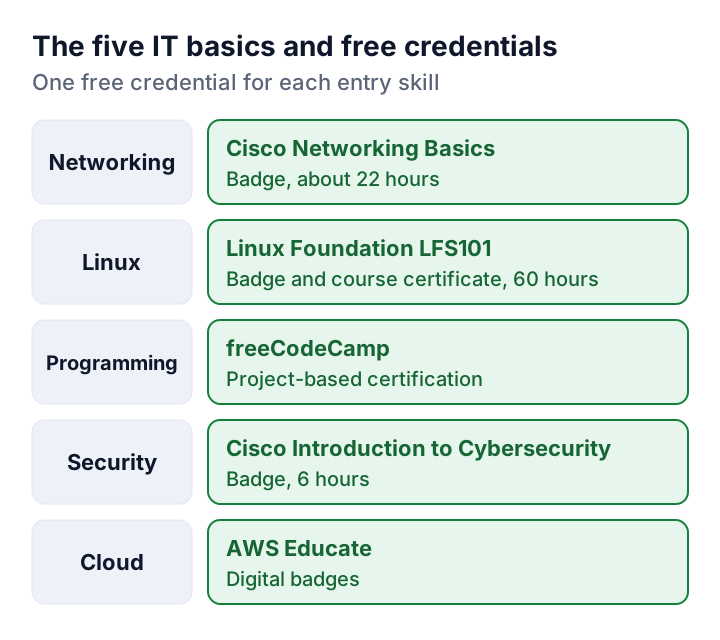
Every IT job assumes the same five basics: how computers and networks work, Linux, one programming or scripting language, security basics and cloud basics. Earn one free credential for each and you have a stack that maps to almost any first role. Here is the best free credential for each one, labelled honestly by kind.
Networking
The best free networking credential is Cisco's Networking Basics course on the Cisco Networking Academy. It is free, self-paced and aimed at absolute beginners, and you earn a Credly badge after the final exam. It runs about 22 hours with 13 hands-on labs. The catch: it is awareness-level content. It will not get you hired alone, and it does not include a voucher for Cisco's paid CCST Networking exam.
A common mistake is to treat that badge as a certification. It is a course badge. The paid CCST Networking exam is a different, harder credential, and the free course is just the on-ramp.
Networking is where many interview questions start, because every cloud runs on a network. A practice question on TCP vs UDP shows the level: knowing why a live voice call uses UDP. Enrol free here: Cisco Networking Basics.
Linux
The best free Linux credential is the Linux Foundation's Introduction to Linux, known as LFS101. It is a 60-hour self-paced course with hands-on labs, and finishing it earns a digital badge and a certificate of completion. The catch is in the small print: free access lasts 90 days, and the badge needs a 70% pass on the final exam. It's also not LFCS, the Linux Foundation's paid certification exam.
The same course also runs on edX as LFS101x, and there the free audit gives you no certificate. Only the Linux Foundation's own site gives the free badge and certificate. Linux powers most servers and the cloud, so a fresher who can move around a terminal stands out.
A practice question on systemd daemon-reload tests the kind of task the course builds toward. Enrol free here: Introduction to Linux. If Linux interviews are your worry, the Linux interview questions guide covers the commands that come up.
Programming
For programming, freeCodeCamp is the best free credential and it really is free. It has no paid tier. You earn each certification by building five projects that pass automated tests, not by sitting a multiple-choice quiz. The long-running certifications run about 300 hours each, and the certificate never expires.
The catch: freeCodeCamp is not a proctored certification. Employers treat it as proof of projects you built, which is fine, because that is what they want to see. One nice detail: the certificate URL is public and stays valid, so anyone can check it.
Pick the Responsive Web Design or JavaScript certification if you are heading for a developer role. Either is a small portfolio in itself. Start here: freeCodeCamp.
Security
The best free security basic is Cisco's Introduction to Cybersecurity, also on the Networking Academy. It is a six-hour course with seven labs that ends in a final exam and a Credly badge. The catch is its size: six hours is an orientation, not a qualification. It carries no exam voucher and no professional standing, so treat it as a map of the field, not a credential that opens security roles. It is the entry point of Cisco's longer Junior Cybersecurity Analyst path, which runs about 120 hours in total.
For a free hands-on check of the same basics, try a Microsoft Applied Skills lab. The "Get started with cloud security and monitoring tasks" assessment is 30 minutes, and you actually do the work in a live environment. A practice question on authentication vs authorization shows the exact wording traps the field sets.
Cloud
For cloud, the best free first step is AWS Educate. It is free training with no credit card. Anyone aged 13 or over can join with just an email address. It awards shareable digital badges such as Introduction to Cloud 101. AWS does not publish a set number of hours.
The catch: an Educate badge is not the AWS certification. The real Cloud Practitioner exam is a separate, paid test. Many people think "free AWS training" means a free exam. It does not. The training and badges are free; the exam costs money.
On the Microsoft side, the free Applied Skills assessment "Get started with Azure management tasks" is a 30-minute beginner lab that earns a credential that never expires. Both sit before you spend a rupee. The paid exam comes later in this guide.
Free IT certification exams freshers can take now
Only one major free real exam is open to everyone: Oracle's OCI Foundations Associate (1Z0-1085-26). OCI is Oracle Cloud Infrastructure. The exam is free with no voucher, and you take it online, unproctored, straight from Oracle MyLearn. It has 40 questions in 60 minutes with a 65% pass mark, and the credential lasts 24 months. All you need is a free Oracle account; the course is recommended, not required.
What goes wrong here: people study the retired 2025 version and fail on code alone. The current exam ends in -26, so check yours matches before you sit. You renew it by passing the current version again. For the full Oracle free picture, see the free cloud certifications guide. Take the exam from Oracle MyLearn.
Popular "free" certifications that aren't free any more
Several credentials still appear on "free" lists but are not free now. Check the dates before you plan around them.
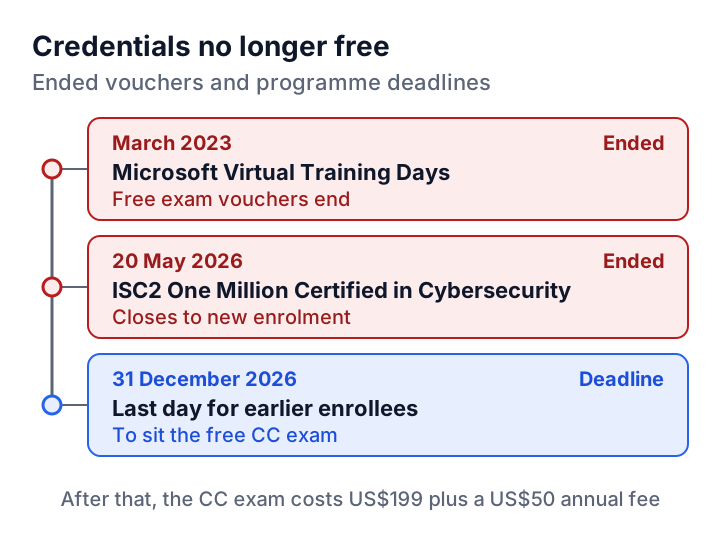
ISC2's Certified in Cybersecurity (CC) was free under the One Million Certified in Cybersecurity programme. That programme closed to new enrolment on 20 May 2026. People who enrolled earlier may sit the exam by 31 December 2026. Everyone else pays: the CC exam costs US$199, plus a US$50 annual maintenance fee after you pass.
The Google IT Support Professional Certificate is a Coursera subscription, not a free certificate. In India it costs ₹1,923 a month after a seven-day trial, and you keep paying until you finish. Financial aid is possible if you qualify. It is a solid beginner course, just not free.
Microsoft Virtual Training Days used to hand out free exam vouchers for attending. Those free vouchers ended in March 2023. Any page promising a free AZ-900 voucher from them is out of date. A good habit is to check the vendor's own page for the current price before you believe a list.
The first paid exam worth saving for
After the free basics, three paid entry exams are worth the money, all priced as of November 2026:
- Microsoft AZ-900 (Azure Fundamentals): US$99. It never expires, so there is no renewal fee.
- AWS Certified Cloud Practitioner (CLF-C02): US$100, or ₹8,553 with a rupee voucher. Valid for three years.
- ISC2 Certified in Cybersecurity (CC): US$199, plus a US$50 annual maintenance fee. Valid for three years.
Pick by your target job. Going for an Azure role or a Microsoft-heavy shop? Take AZ-900 first. Going for AWS? Take CLF-C02.
Aiming at security? The CC is the entry exam to beat, once you have the budget. If your first target is a help-desk or IT support role, you do not need all three. The free basics plus one of AZ-900 or CLF-C02 is enough to start.
For a fuller comparison of the three first cloud exams, see the beginner's guide to choosing, and for what CLF-C02 is worth on a CV, see AWS Cloud Practitioner jobs.
For each one, free practice is here. Use the CLF-C02 test page and its question list, and the AZ-900 test page and its question list. The Linux, networking and security basics have free practice topics too, though they are not vendor exams. You can reach them at Linux and its questions, networking and its questions, and security fundamentals and its questions.
The trap: people pay for an exam, do no free practice, fail, and pay again. Free practice first is the cheapest insurance. Try a practice question on the shared responsibility model to see how CLF-C02 tests who fixes what, and a practice question on cloud service types for the AZ-900 angle.
A 90-day free plan for freshers
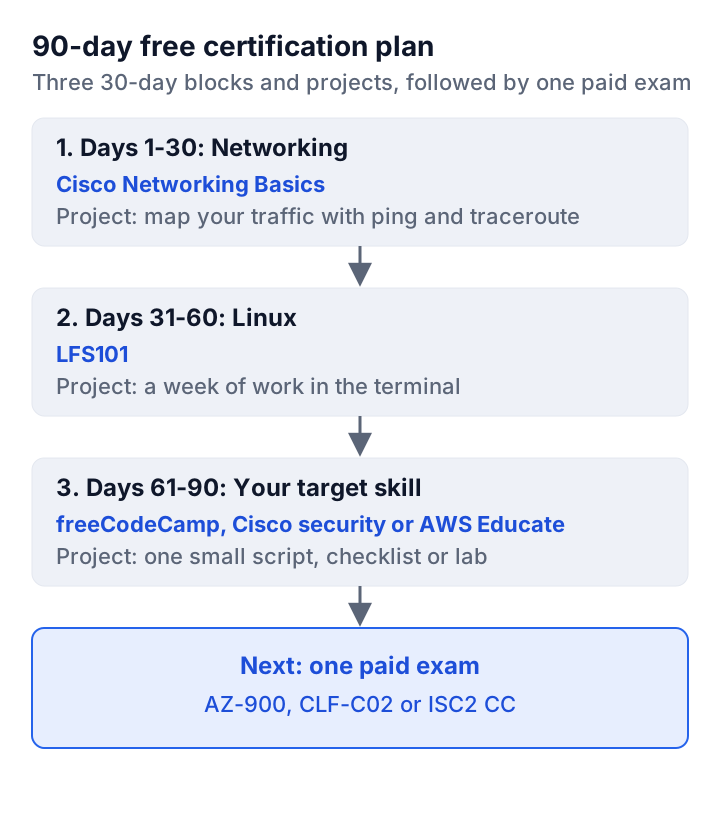
Here is a 90-day plan in three 30-day blocks. Each block pairs one skill with its free credential and a small project you can point to in an interview. An hour a day is enough. Pick a fixed hour so the streak survives a busy week.
- Days 1-30, networking. Finish Cisco's Networking Basics. Project: set up a small home network, or map your own traffic with ping and traceroute and write down what each hop does. A practice question on TCP/IP layer mapping checks the terms you learned while doing it.
- Days 31-60, Linux. Work through LFS101. Project: install a Linux distribution in a virtual machine and do a week of real work in the terminal instead of a desktop app.
- Days 61-90, your target skill. Pick the skill your target job needs: programming (freeCodeCamp), security (Cisco's Introduction to Cybersecurity or the Microsoft cloud security Applied Skills), or cloud (AWS Educate). Project: build one small thing, a script, a security checklist, or a free AWS lab, and write two lines on why you made each choice.
By day 90 you have three or four real credentials and three projects. That is a stronger start than 15 unconnected course certificates.
How to put free certifications on your CV
The label you use matters more than the credential. Put only real exams under a heading called "Certifications". Put badges and course certificates under "Training", with the issuer and the year. Never write "certified" for a course you completed. "Certified in Cybersecurity" is a claim about a proctored exam; "completed the Cisco Networking Basics course" is the honest version.
What goes wrong: a candidate who writes "AWS certified" for an Educate badge gets caught in one search, and the whole CV loses trust. An honest "Training" section reads as someone who knows the difference, which is itself a small signal to a hiring manager.
List each credential once, not twice. A badge that sits in both "Certifications" and "Training" looks like padding. For the next step by role, see the free AI certifications, free data analyst certifications and free DevOps certifications guides.
Frequently asked questions
Which IT certification is best for freshers?
There is no single best one; the best one is the one your target job names. Start with the free basics, networking, Linux, programming, security and cloud. Then save for the paid exam that matches your goal: AZ-900 for Azure, CLF-C02 for AWS, or the ISC2 CC for security.
Is there a free cybersecurity certification for freshers?
Not a real proctored one right now. The one genuinely free security exam, ISC2's CC under the One Million programme, closed to new enrolment on 20 May 2026. Free security basics now come as badges and labs, such as Cisco's Introduction to Cybersecurity and Microsoft's cloud security Applied Skills.
Are free certificates valid for jobs?
They are valid as proof of training, not as certification. Badges and course certificates show effort and belong under "Training" on your CV. They will not carry the weight of a proctored exam, so use them to build the basics, then take one paid exam.
Is the Google IT Support certificate free?
No. It is a Coursera subscription of about ₹1,923 a month in India after a seven-day trial, and financial aid is possible. The course content is strong, but the certificate is not free.
Can I get AZ-900 or AWS Cloud Practitioner for free?
Not the exam itself. The training is free on Microsoft Learn and AWS Skill Builder or AWS Educate, but the exams cost US$99 and US$100 as of November 2026. Microsoft's free vouchers ended in March 2023, and AWS free vouchers come only through a programme such as Student Rewards or re/Start.