Free DevOps certifications: what's free and what to pay for
As of November 2026, there is no free DevOps certification exam open to the public. What is free: the Linux Foundation's intro courses with badges, Microsoft's Applied Skills labs and AWS's hands-on microcredentials. The cheapest real DevOps exam is Terraform Associate, at US$70.50.
That matters because most "free DevOps certification" lists send you to course certificates, or to student vouchers that have already run out. You can still build real, provable skills before you have an exam budget. By the end, you'll know which free credentials to earn first and which paid exam to save for.
Is any DevOps certification free in 2026?
DevOps joins software delivery with the work of running it. A proctored exam checks your identity and watches you during the test. As of November 2026, the public DevOps exam routes covered here all charge a fee.
The word "certificate" doesn't tell you what was tested. A gym attendance card and a weightlifting competition result both prove something, but not the same thing. So sort every award by what you had to do to earn it:
- Certification exam: a separate vendor test, with its own fee, format and renewal rules.
- Badge or hands-on assessment: evidence of specific knowledge or tasks, with the issuer's earning rules.
- Course certificate: evidence that you completed a course and any required checks.
- Training only: useful lessons, with no credential at the end.
For example, continuous integration and continuous delivery (CI/CD) automate code checks and prepare releases. Continuous delivery can still need approval before a release reaches users. Try a practice question on delivery versus deployment to check that distinction before choosing a pipeline course. A pipeline is the sequence of steps that builds, tests and releases your code.
The professional DevOps certification comparison covers the advanced exam choices. For broader cloud options, use the free cloud certifications guide. Passing a free cloud exam doesn't make you a certified DevOps engineer.
Free DevOps courses with a badge: the Linux Foundation's three
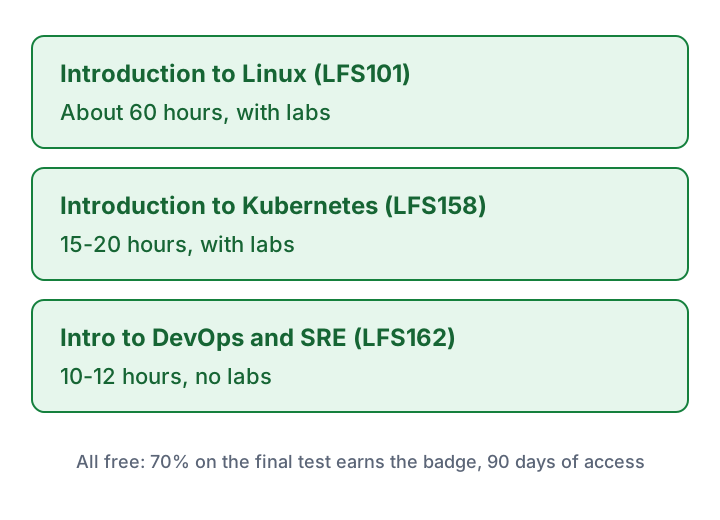
Start here if you're new to Linux or containers. The Linux Foundation offers these courses free through its own training site with a free account. Each gives a digital badge and a completion certificate when you finish the course and pass its test.
Introduction to Linux (LFS101)
Linux is an operating system you'll use to run commands and manage applications. Introduction to Linux is a beginner course for people with everyday computer skills. Its self-paced format includes hands-on labs and an estimated 60 hours of study.
The unproctored final test needs 70% for the badge. No expiry is stated for the badge or course certificate. The catch is access: free enrolment lasts 90 days, so start when you can study regularly.
Don't only watch demonstrations of commands. Work through a practice question on hard versus symbolic links to see why deleting a file name can leave another link working or broken. That small file exercise makes a course topic easier to remember.
Introduction to Kubernetes (LFS158)
A container packages an application with the files it needs to run. Kubernetes manages containers across a group of machines. Introduction to Kubernetes provides self-paced lessons and labs, with 15-20 hours of estimated study.
Some Linux administration knowledge helps, but isn't required. You need 70% on the unproctored final test for the badge, which has no stated expiry. Access lasts 90 days; completing this course doesn't award a Kubernetes certification or include its exam fee.
Introduction to DevOps and Site Reliability Engineering (LFS162)
Site reliability engineering applies software engineering methods to keeping services reliable. LFS162 introduces that work alongside DevOps. It takes an estimated 10-12 hours and expects Linux, networking and scripting knowledge.
This self-paced course lists no hands-on labs. Its badge needs 70% on an unproctored final test and has no stated expiry. You have 90 days of access, so don't mistake the shorter duration for a course needing no background.
Use the Linux Foundation enrolment pages above. The similar edX courses have a free audit option, meaning you can view lessons without buying the verified certificate. That audit option doesn't include the certificate.
Free hands-on DevOps credentials
A course can show you how a release works without asking you to carry it out. These options add assessments, though some check knowledge and others require practical work. Choose the task you want to practise before collecting the badge.
Microsoft Applied Skills: secure, test or deploy
Microsoft's Applied Skills credentials test a focused task. These courses and labs are free with a Microsoft Learn account. You don't need a student voucher or a payment method for these assessments.
- Implement security through a pipeline using Azure DevOps checks how you secure a release pipeline.
- Automate Azure Load Testing by using GitHub Actions checks automated performance testing.
- Deploy cloud-native apps using Azure Container Apps checks container application deployment.
Load testing checks how an app behaves when more work arrives. For example, a release process might test performance before allowing the app to reach users. Pick the GitHub Actions assessment if you already understand its workflows, the files that define automated tasks.
As of November 2026, these are online, unproctored labs with 12-16 tasks in 45 minutes. The awards don't expire. These are intermediate tasks: learn the tools first, including containers for the Container Apps route.
The catch is the lab session. You must finish without pausing, and a failed attempt means a 72-hour wait before retrying. These credentials don't award Microsoft's DevOps Engineer Expert certification.
AWS knowledge badges and Cloud Ops
Amazon Web Services (AWS) offers free learning and assessment routes through AWS Skill Builder. Its Serverless Knowledge badge covers applications where AWS manages the servers for you. Both the learning plan and the online assessment are free; you need 80% to earn the badge.
The AWS Knowledge: Amazon EKS badge is another free training and assessment route. Amazon Elastic Kubernetes Service (EKS) is AWS's managed Kubernetes service. AWS lists this badge among its free digital courses, and its general knowledge-badge threshold is 80%.
AWS doesn't publish expiry rules for these knowledge badges. The public descriptions also don't establish assessment lengths or proctoring. Serverless assessment retakes have a 24-hour wait; don't assume every AWS badge has that same rule.
If you're new to operations, try AWS Educate Getting Started with Cloud Ops. AWS Educate offers free training, labs and the badge route to learners aged 13 or over. You sign up with email and don't need a credit card.
You earn this badge through online training and an end-of-course test. Its expiry, assessment length and proctoring aren't published in the public badge details. The catch for all these training badges is that none awards an AWS Certification exam pass.
AWS Serverless Demonstrated and MLOps Demonstrated
Want an assessment where you actually fix something? AWS Serverless Demonstrated checks hands-on work with AWS serverless services. It's a microcredential, an award for a focused set of skills.
Machine learning operations (MLOps) means deploying and running machine learning models. AWS MLOps Demonstrated checks that work, including model deployment and scaling. It's the more relevant choice if your project involves running models rather than a general application.
Both assessments are free without a Skill Builder subscription. They use timed online labs with no multiple-choice questions and remain valid for 1 year. Public descriptions don't give their exact duration or proctoring; read each assessment's retake policy before starting. For other AI options, see the free AI certifications guide.
Google's Terraform skill badge
Infrastructure as code means defining servers and other resources in files you can reuse. Terraform is a tool for managing infrastructure this way. Google's Build Infrastructure with Terraform on Google Cloud badge checks practical use through labs and a final unproctored challenge lab.
The challenge lasts about 60 minutes, and the badge doesn't expire. You should already know basic Google Cloud and command-line work. Google Skills is the current platform name for the training previously offered through Google Cloud Skills Boost.
The free route depends on credits, the units used to pay for labs. Google offers developers 35 free credits each month. Check the lab cost before starting: a timeout can use up credits without earning the badge. This isn't HashiCorp's Terraform Associate certification.
Free training with no credential, and the myths around it
Imagine finishing a video course and looking for an exam voucher in your account. A free course doesn't promise one. These resources can help you learn without giving you a free vendor certification.
GitLab University
GitLab University offers free self-paced courses and learning paths. Its certification exams cost US$150 each as of November 2026; free exams for GitLab team members aren't a public offer. Use the free learning, then treat exam registration as a separate purchase.
Red Hat technical overviews
Red Hat offers free on-demand video overviews: RH024 for Linux, AU094 for automation and DO080 for containers. Its training catalogue separates these from paid exams. The videos award no badge or certificate, so there's no credential expiry to track.
These overviews don't include an exam voucher or a complete practical lab course. Watching a Linux demonstration is useful preparation, but you still need to try the commands yourself. Don't list video attendance as a Red Hat certification.
Docker training and the DCA myth
Docker's self-guided training provides free written guides and videos. Docker, Inc. runs no certification of its own and awards no credential for these modules. There's therefore no expiry or renewal, while the linked LinkedIn Learning certificate requires a subscription.
The Docker Certified Associate (DCA) is run and sold by Mirantis. It's a paid exam, covered below. While learning Docker, try a practice question on multi-stage builds for a smaller image. An image is the packaged template a container runs from; this example leaves build tools out of that final package.
The cheapest paid DevOps exams, by price
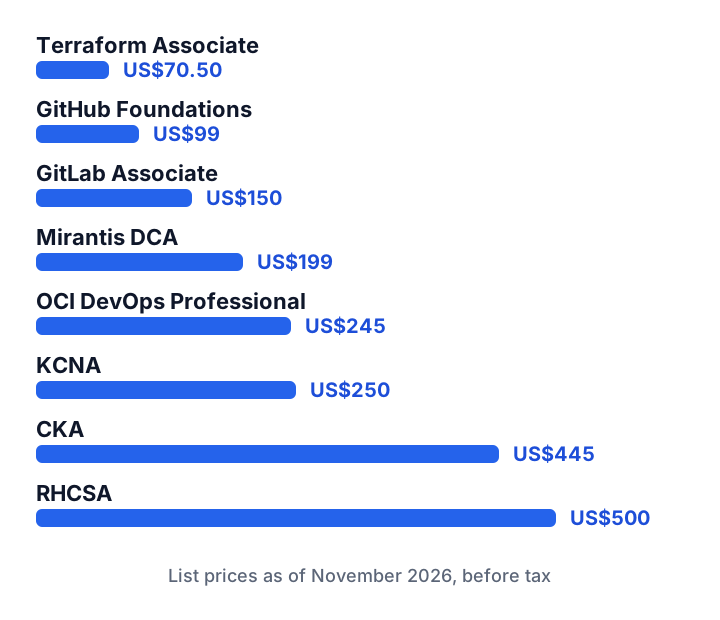
These list prices and formats are as of November 2026. Start with the work you want to do: a cheap Terraform exam won't assess Kubernetes administration. Free study material can reduce preparation costs, while retakes and tax can still increase what you pay.
Terraform Associate (004): US$70.50
HashiCorp's Terraform Associate is the cheapest certification exam in this set. It tests Terraform 1.12 through a 1-hour, online proctored multiple-choice exam. Free tutorials help you prepare, but the exam costs US$70.50 plus local taxes and fees.
The award lasts 2 years, and no free retake is included. A failed attempt means paying again. Use the Terraform Associate guide to check the objectives before booking.
GitHub Foundations and Actions: US$99 each
GitHub Foundations suits beginners learning GitHub collaboration. GitHub Actions targets people already building automated workflows. Both cost US$99, with pricing set by the country where you test.
Both are proctored, with multiple-choice and interactive items in 100 minutes. Learning materials and practice assessments are free, but neither exam includes a free retake. Microsoft Learn says Foundations needs no renewal; Actions is valid for 2 years.
The student voucher offer ended on 3 November 2026. GitHub's Student Developer Pack changelog reported exhausted supplies on 5 November 2026. The offer may return, but don't budget around that possibility. It didn't cover the Actions exam.
GitLab Associate exams: US$150
GitLab's Fundamentals Associate and CI/CD Associate are paid certification exams. The candidate handbook describes 50 multiple-choice or multiple-response questions in 75 minutes, online and unproctored. Free learning paths don't remove the US$150 fee.
You get 2 attempts within 14 days. Certifications don't expire, though major product changes can trigger recertification requirements. Buy when you're ready: the short access window and no-refund rule make early purchase a poor way to set a study deadline.
Mirantis DCA: US$199
Mirantis sells the DCA for US$199 per attempt. It's a remotely proctored, 90-minute exam with 55 questions, using multiple-choice and a format that shows answer choices separately. The award lasts 2 years; free Docker lessons don't include this exam.
The catches are paid retakes and computer support. Mirantis supports Windows or macOS for the exam, so a Linux study machine alone won't meet its requirements. Check that before buying.
Oracle Cloud Infrastructure DevOps Professional: US$245
Oracle Cloud Infrastructure (OCI) DevOps Professional is a paid certification exam. Oracle's pricing guidance lists US$245 for Professional exams and 24-month validity for OCI credentials. Free learning content doesn't include this exam, and another attempt costs another fee.
Check the booking page for its current assessment format. Oracle's free-credential offers don't make its DevOps Professional exam free. Choose it for OCI work, rather than simply because you've seen an Oracle free-exam promotion.
KCNA: US$250; CKA: US$445
The Kubernetes and Cloud Native Associate (KCNA) is a proctored, 90-minute multiple-choice exam. It costs US$250 with 1 free retake. The Certified Kubernetes Administrator (CKA) costs US$445 with 2 attempts and uses 2 hours of practical tasks on a live Kubernetes system.
Both credentials last 2 years. Free LFS158 training includes neither exam, and the purchase window gives you 12 months to take the exam. The CKA exam guide explains booking; the Kubernetes certification guide helps you choose.
Try a practice question on stable names with a headless Service to test the networking concepts behind administrator work. A headless Service lets applications find individual running instances directly. For CKA, follow concept practice with actual command-line tasks.
RHCSA: US$500
Red Hat Certified System Administrator (RHCSA) costs US$500 at standard list price. Its proctored EX200 exam uses practical system tasks over 3 hours, and the certification stays current for 3 years. Free overview videos don't include exam access; the first retake after a failed attempt is free.
DevOps certification for freshers: a free-then-pay path
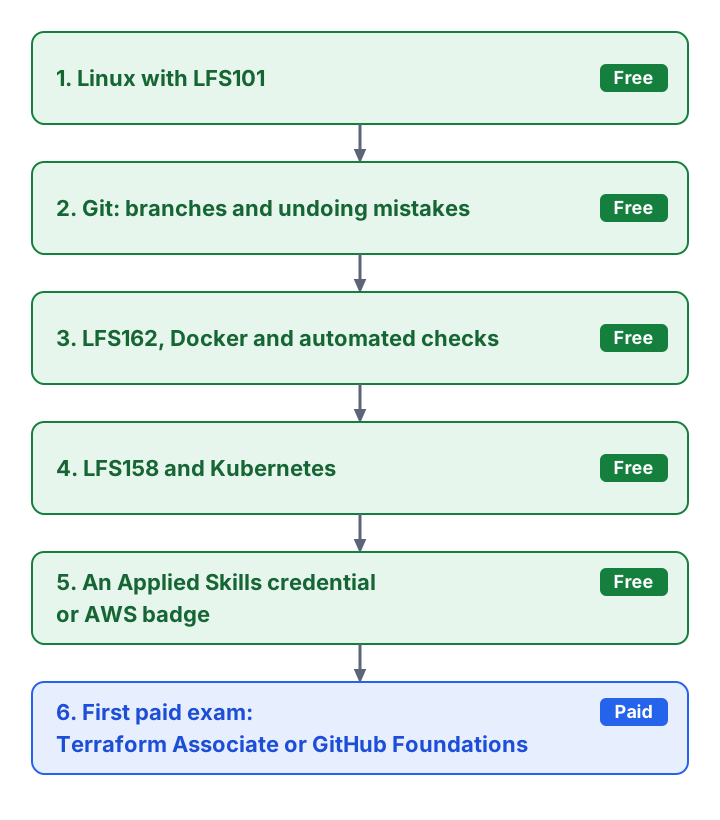
Build a small application you can change, test and run. Git records changes to your files, so it fits naturally before automating releases. The Linux, git, Docker and CI/CD resources here are free practice topics; they aren't vendor certification exams.
- Learn Linux commands with LFS101, then practise files, permissions and basic troubleshooting.
- Learn git by saving changes, sharing a branch and safely undoing a mistake.
- Take LFS162, then package your application with Docker and add automated checks.
- Take LFS158 after containers make sense, then practise running your application with Kubernetes.
- Earn a relevant Microsoft Applied Skills credential or AWS badge, and keep notes on what you did.
- Pay for Terraform Associate if infrastructure work fits, or GitHub Foundations if you need collaboration basics first.
Use the Linux practice topic and Linux question list to check your command-line base. Then use the git practice topic and git question list before sharing code. A practice question on reverting a pushed commit shows how to undo a mistake without rewriting a shared branch's history.
Move to the Docker practice topic and Docker question list when packaging your app. Use the CI/CD practice topic and CI/CD question list when adding checks to the pipeline. A practice question on the test pyramid and fast feedback explores why slow, unreliable tests need better test design rather than more retries.
If Kubernetes administration becomes your goal, use the CKA exam practice page and CKA question list. CKA is the paid vendor exam in this group; you'll also need practical lab work. Use the DevOps interview guide to practise explaining your project and its failures before applying for roles.
Frequently asked questions
Is there any free DevOps certification?
As of November 2026, no proctored DevOps certification exam here is free to the public. You can earn free course badges, Microsoft Applied Skills credentials and AWS assessment awards. For example, a free pipeline lab earns its own credential without awarding a professional DevOps certification.
Is the Kubernetes certification free?
No: as of November 2026, KCNA costs US$250 with 1 free retake, and CKA costs US$445 with 2 attempts. The Linux Foundation's LFS158 course is free and offers a course badge. Completing it doesn't pay for either certification exam.
Are Linux Foundation free courses worth it?
Yes, when you use their lessons to practise the work. LFS101 and LFS158 include labs; LFS162 introduces DevOps and reliability concepts. List the resulting awards as course badges or completion certificates, and be ready to explain what you learned.
Is the GitHub certification free for students?
The student voucher offer ended on 3 November 2026, and GitHub reported exhausted supplies on 5 November. As of November 2026, Foundations and Actions each cost US$99, with country-based pricing. The offer may return, but there's no promise of another voucher round.
Which DevOps certification is best for freshers?
Start with free Linux and git practice, then build a project before buying an exam. Terraform Associate fits a first infrastructure focus, while GitHub Foundations fits collaboration basics. Choose the test that matches work you can explain, rather than the most advanced title.